


On this day: Roger Federer wins the first Masters 1000 title in Hamburg

In his second full season on the ATP Tour, Roger Federer clinched 49 wins and the first ATP crown in Milan in 2001, finishing the year just outside the top-10. The 21-year-old was ready to rumble even harder in 2002, reaching the first Masters 1000 final in Miami that he lost to Andre Agassi in four sets. The results were not that good in Monte Carlo and Rome before Roger pulled everything together in Germany (Hamburg was always his favorite clay Masters), beating Gustavo Kuerten and Marat Safin to lift the first ATP title on clay and the first at Masters 1000 level. Also, with these 500 points, Federer found himself in the top-10 for the first time next morning, finally cracking the elite group almost 16 months after he found himself in the top-20. In the title match, Roger took down world no. 5 Marat Safin 6-1, 6-3, 6-4 in two hours and two minutes, scoring eight breaks and keeping the points on his racquet all the time.
This was their first meeting and Roger outplayed another rock-solid youngster in the first hour of the match, winning 11 out of the first 13 games to seize the full control over the scoreboard. Marat did manage to raise his level a little bit in the final set but it wasn't enough to make a turnaround or at least to win a set, making too many errors in the end. After a surprising loss to Thomas Johansson in the final of the Australian Open, Safin lost the ground a little bit in the first half of 2002 before finding the form again on clay, reaching the semi-final at Roland Garros as well. Nonetheless, the Russian was powerless most of the time against the young Swiss who delivered everything he already possessed in the packed arsenal. Roger served at only 53% but his initial shot worked like a charm, saving four out of seven break points to limit the damage and force Marat to pull the same numbers if he wanted to stay competitive.
The Swiss had 24 errors from his backhand but also 12 winners, enough to keep him in front almost all the time as Marat never found a good rhythm from his left wing. Also, we saw some well-constructed defensive backhands from Federer, who sliced them nicely to find both depth and accuracy that left Safin with nothing to work on. Federer did a lot of damage with his forehand, opening the court and forcing errors from his opponent, also leaning upon the movement that helped him to cover the court supremely and make Marat chasing lines and risky shots, which didn't end well for the Russian as the result suggests. As a natural attacker, Federer embraced every opportunity to rush to the net and keep the points on his racquet, taming his shots more efficiently and feeling confident after blasting a huge amount of winners from all over the court.
Marat never found the range and was toppled in the mid-range rallies too, plagued by almost 60 mistakes overall. The Russian restored his first serve percentage after the opening set but that didn't bring him much, having problems in 12 out of 13 games on his serve! Roger won 53% of the return points and created no less than 17 break points, converting eight for an upper hand in the biggest part of the match, especially in the first two sets. Safin had 25 service winners, seven more than Roger, although he needed more to feel comfortable in his games, with the pressure on him all the time. Federer lost 40% of the points behind the initial shot but mostly in the closing stages of set number two and the third when he started to struggle a little bit, still good enough to bring the match home in straight sets.
As we already said, Safin had more service winners but Roger was the ruler on the court when it comes to direct points from the field, hitting monstrous 32 winners compared to just 16 from his rival. Federer landed 12 backhand winners, backed by 11 from his forehand and six that came at the net with volleys, reducing Marat to just 12 forehand and backhand winners combined. Safin committed 32 unforced errors, 19 from his backhand wing, and Roger stayed on 22, locking his backhand on 14 mistakes. Marat also added 27 forced errors (15 from the backhand side), a nice illustration of Roger's supremacy from the baseline, and the winner was never in doubt when we check the total number of winners and errors. Thanks to those service winners, Safin was 58-46 in front in terms of the shortest points that ended with a maximum number of four shots, staying up there with Roger in the longest points as well, winning 14 against 16 for the Swiss.
Nonetheless, Federer destroyed his opponent in the mid-range rallies from five to eight strokes, conquering 49 out of 64 to leave Marat in the dust. It is not often you see such a big difference in any statistical element, especially not in the Masters 1000 final, but Marat was just feeble and fragile once the rally would mature a little bit, which brings us to that huge amount of errors he made. Roger held at love in the first game of the match, which is always important, and reached two deuces on the return in the next game before Safin put his name on the scoreboard with three service winners. From 30-0 down in the third game, Federer grabbed four points in a row to move in front once again, hitting two service winners and another one from his forehand. Marat was still searching for his shots and got broken in game four after four errors, finding himself 4-1 down when Roger held a few minutes later.
Nothing worked well for the Russian who lost serve again in game six after wasting two game points. He took two 16-stroke rallies but his errors kept Roger in the game until losing another service game. Federer needed no second invitation to bring the opener home, cracking four winners at 5-1 to close the opener after some 25 minutes. Marat served at only 48% and needed much more than that to be competitive, as his groundstrokes were just not there. Roger was 8-4 in front in terms of service winners and 5-3 in winners from the field, staying on only nine errors while Marat counted to 17. The Russian made ten unforced errors, six more than the Swiss, and it was 7-5 in forced errors for Safin who was beaten in every segment, leaving with a lot of work to be done from set number two. Federer continued where he left in the first set, breaking at the start of the second to gain full control over the scoreboard.
Marat couldn't control his anger anymore after giving Roger a break point, breaking his racquet and allowing Federer to convert it with a beautiful backhand lob that stayed out of Safin's reach. Another commanding hold pushed Roger 2-0 up, firing three winners and dominating the court so far. The third game brought more troubles for Marat who held after three deuces and two break points offered to Roger for at least some kind of boost and momentum. Nonetheless, the Swiss player was still sailing through his service games, creating a 3-1 gap and breaking again in game five to increase the lead. This time, the Moscow native squandered three game points and paid the price in the end when Roger hit an amazing running forehand to pretty much seal the second set. Another four winners gave Roger a 5-1 lead, closing the game with a great 19-stroke rally.
Safin struggled once again on serve in the next game and had to save two set points to avoid the repeat of the first set scoreline. From 40-15 down, he delivered four winners to reduce the deficit to 5-2 and prolong the set at least for one more game. Roger served for two sets to love lead, creating a set point with three winners but this time it was Safin who played with more focus and stamina, staying in the game and creating his first break point with a touchy backhand lob winner. He converted it thanks to a good return in the next point and this already looked much better from what might have happened just a few minutes ago when he avoided losing serve again. Still, Marat couldn't stay in touch for too long, wasting four game points at 3-5 to drop serve again, allowing Federer to close the set 6-3 and move just a set away from the triumph.
Roger was the one who struggled to find the first serve in set number two (44%) although we couldn't notice that in his games, playing against just one break point. On the other hand, Marat served at 70%, a significant improvement from the first set but not enough to get the breathing space, pushed to the distance in every service game and suffering three breaks. Safin was now in front when we speak about service winners (11-4) and Roger was simply amazing once the rally was on, firing 19 winners and leaving Marat on seven, a huge difference created in just nine games. Federer made a little bit more errors in this set but felt comfortable to do so with that number of winners by his name. Safin had ten unforced errors in comparison to nine from Roger and it was 8-7 in forced errors, that also couldn't make the difference for either of the players.
Marat was in a very tough position, with a mountain to climb in front of himself, having at least some hopes after raising his level in the closing stages of the second set, starting to return more efficiently and create chances. Also, Federer was missing more, unable to keep the level that gave him a 6-1 5-1 advantage and facing three break points at the beginning of the third set. The Swiss managed to fend them off and to bring the game home, breaking in the next game to create a 2-0 gap. This was the ninth service game for Safin since the start of the match and he was yet to make a hold without troubles. Marat saved the first two break points before Roger converted the third to put one hand on the trophy, forcing the 13th backhand error from his rival. Nonetheless, Federer lost his focus in the third game, dropping serve at love with four errors to keep Marat in contention after the worst game he played in the entire clash.
After two deuces in game four, Safin held to level the score at 2-2 and stand on the positive side of the scoreboard for the first time since the start of the match. The light at the end of the tunnel became even brighter for the Russian after scoring another break in game five to take the first lead, using his forehand to dictate the points and drawing more errors from the Swiss. Instead of building a 4-2 lead, Safin got broken in game six after squandering three game points, missing an easy backhand that brought Roger back on the scoreboard. Federer regained the advantage with an ace at 3-3 but Safin responded with his first easy hold of the match to level the score and stay in contention, setting an interesting enclosure of the set.
Federer held at 15 for a 5-4 and to finish his part of the job, leaving Marat to serve to stay in the match, with no room for errors. He couldn't avoid them, though, spraying four shots long to hand the break and the triumph to his opponent who celebrated his biggest title of the career so far with tears in his eyes. In set number three, Marat hit ten service winners and Roger stayed on six while the Swiss again had the upper hand in the winners from the rallies, the smaller one than in the previous sets (8-6). The Russian made five errors more (12-9 in unforced, 12-10 in forced) and this was by far the most interesting part of the encounter, although Marat woke up too late to make a turnaround.
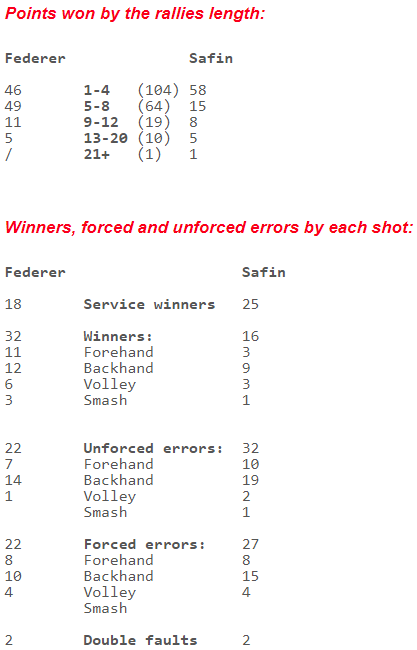
from Tennis World USA http://bit.ly/2VzC8UH
No comments